


|
|
|---|


Selasa, 29 September 2009
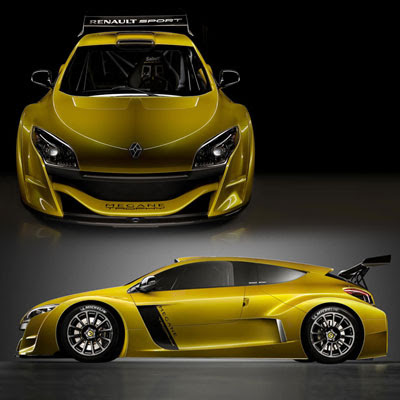
The 2009 Renault Megane Trophy is based on the new Megane Coupe which is powered by the Renault-Nissan Alliance’s mid-rear 3.5-liter V6 24V engine that produces 360 hp.
The front and rear light units and windscreen are from the Megane Coupe road car while flowing lines of the bodywork was designed from digital simulation technology to improve the aerodynamic.
The Renault Megane Trophy features front splitter which channel air flow to the extractors and rear diffuser and wing that generated downforce. Downforce has improved by 20 % with the refinements to the set-up and drag was reduced by 15 % , which together, represent a gain of almost 40% in terms of the new car’s aerodynamic performance over the previous generation vehicle.
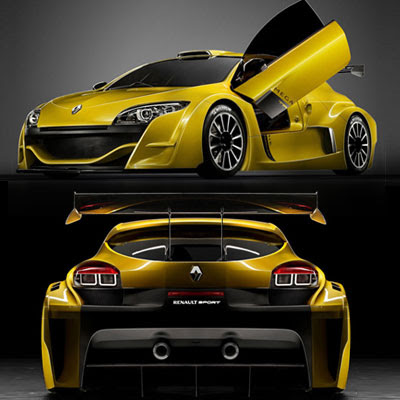
Apart from that, the Megane Trophy also features butterfly doors reminiscent of the world of GT and sports-prototype racing. The V6 3.5 24V engine is mated to a semi-automatic gearbox with the same mechanical features as the current car, including an FIA-homologated sports-prototype tubular chassis, steering wheel-mounted paddle shift, double wishbone suspension with adjustable dampers, 18-inch wheels and Michelin tires.
The power of the standard 330 hp engine was boosted to 360 hp with the help from the new inlet manifold. Rebuild is still at every 5,500 km for the car’s reliability. According to Renault, with the new aerodynamic gains, the extra power from the engine will enable the 2009 Renault Megane Trophy to lap in similar times to those of a Porsche GT3.
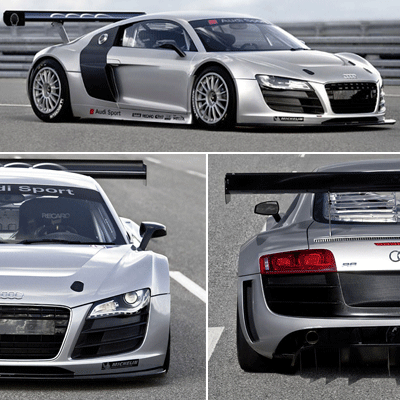
The Audi R8 conforms to the production-based GT3 regulations allowing the car to be fielded in numerous national and international race series.
Because the GT3 regulations prohibit the use of four-wheel drive the Audi R8 comes with the typical GT rear-wheel drive. The power is transmitted via a newly developed six-speed sequential sports gearbox. The suspension uses almost exclusively components from the production line. A comprehensive list of safety equipment guarantees the highest-level of passive safety. A modified front end and a large rear-wing generate the required downforce for the race track.
The Audi R8, which bears the project name “R16” within Audi Sport, was developed under the direction of Audi Sport. Mid August, the first prototype successfully completed a roll-out in the hands of Audi factory driver Frank Biela.
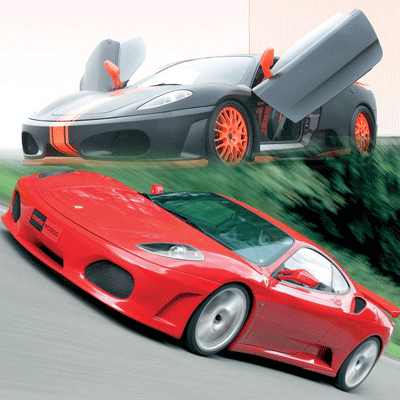
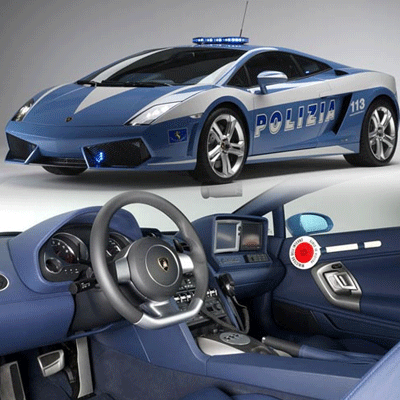
The new Lamborghini Gallardo LP560-4 Polizia, which replaces the previous Lamborghini Gallardo Police Car in use by the Italian police force since 2004 has a 560 horsepower engine that can reach speeds of up to 203 mph. The car will begin service with the Lazio Highway Police Department in order to continue accident and crime prevention to sustain security on the Italian roads.
Its predecessor is proof of Lamborghini’s outstanding product quality. Since 2004, Rome’s police force has had the first-generation Lamborghini Gallardo in regular police service. The sports car has clocked nearly 87,000 miles of patrol duty on the motorways of central and southern Italy, as well as on emergency medical transport detail.
Minggu, 06 September 2009
 The BMW Group officially introduced the concept of environmentally clean sports car EfficientDynamics, which the public will be presented in September at the Frankfurt Motor Show. As stated in a press release, the car combines the dynamics of the "charged" version of the BMW M-and high fuel efficiency of hybrids.
A prototype of BMW EfficientDynamics in landing formula 2 +2 is built on an aluminum chassis and most of his body is created from a special polycarbonate glass, which automatically darken in bright sunlight. The car is equipped with a hybrid power plant consisting of a three-cylinder 163-strong turbodiesel capacity of 1.5 liters, which works in tandem with robotized transmission with dual-clutch, and two electric motors - one for each axis. This capacity is located in the front 80-strong motor, if necessary, can for 30 seconds to increase to 112 horsepower, or 10 seconds - up to 139 horsepower. The total capacity of the powerplant makes 356 horsepower and maximum torque of 800 Nm.
In these BMW, from zero to "hundreds" of a concept sports car can accelerate in 4.8 seconds and reach a top speed of 250 kilometers per hour, limited to that point electronics. Average fuel consumption of cars is equal to 3.76 liters per hundred kilometers, and the level of emissions CO2 - 99 grams per kilometer. Cruising prototype BMW EfficientDynamics when moving in pure electric is 50 kilometers, connecting the diesel increases to 690 kilometers.
As detailed in the company of BMW, the distribution of energy, time to connect motors and other components of the work of the power plant is calculated computer, which through the data with navigation systems, automatic stop and start the engine is able to "predict" situation on the road in front of the car. In accordance with this system prepares the necessary systems to work and accumulates and redistributes the energy to their work.
Charge lithium-polymer battery power pack from ordinary household outlet with 220 volts will take 2,5 hours, and at a voltage of 380 volts only 44 minutes. In addition, the car is equipped with a system of energy recovery during braking.
As previously reported, the serial version of the sports car BMW EfficientDynamics will be the end of 2012 and will be released a limited series.
The BMW Group officially introduced the concept of environmentally clean sports car EfficientDynamics, which the public will be presented in September at the Frankfurt Motor Show. As stated in a press release, the car combines the dynamics of the "charged" version of the BMW M-and high fuel efficiency of hybrids.
A prototype of BMW EfficientDynamics in landing formula 2 +2 is built on an aluminum chassis and most of his body is created from a special polycarbonate glass, which automatically darken in bright sunlight. The car is equipped with a hybrid power plant consisting of a three-cylinder 163-strong turbodiesel capacity of 1.5 liters, which works in tandem with robotized transmission with dual-clutch, and two electric motors - one for each axis. This capacity is located in the front 80-strong motor, if necessary, can for 30 seconds to increase to 112 horsepower, or 10 seconds - up to 139 horsepower. The total capacity of the powerplant makes 356 horsepower and maximum torque of 800 Nm.
In these BMW, from zero to "hundreds" of a concept sports car can accelerate in 4.8 seconds and reach a top speed of 250 kilometers per hour, limited to that point electronics. Average fuel consumption of cars is equal to 3.76 liters per hundred kilometers, and the level of emissions CO2 - 99 grams per kilometer. Cruising prototype BMW EfficientDynamics when moving in pure electric is 50 kilometers, connecting the diesel increases to 690 kilometers.
As detailed in the company of BMW, the distribution of energy, time to connect motors and other components of the work of the power plant is calculated computer, which through the data with navigation systems, automatic stop and start the engine is able to "predict" situation on the road in front of the car. In accordance with this system prepares the necessary systems to work and accumulates and redistributes the energy to their work.
Charge lithium-polymer battery power pack from ordinary household outlet with 220 volts will take 2,5 hours, and at a voltage of 380 volts only 44 minutes. In addition, the car is equipped with a system of energy recovery during braking.
As previously reported, the serial version of the sports car BMW EfficientDynamics will be the end of 2012 and will be released a limited series.


